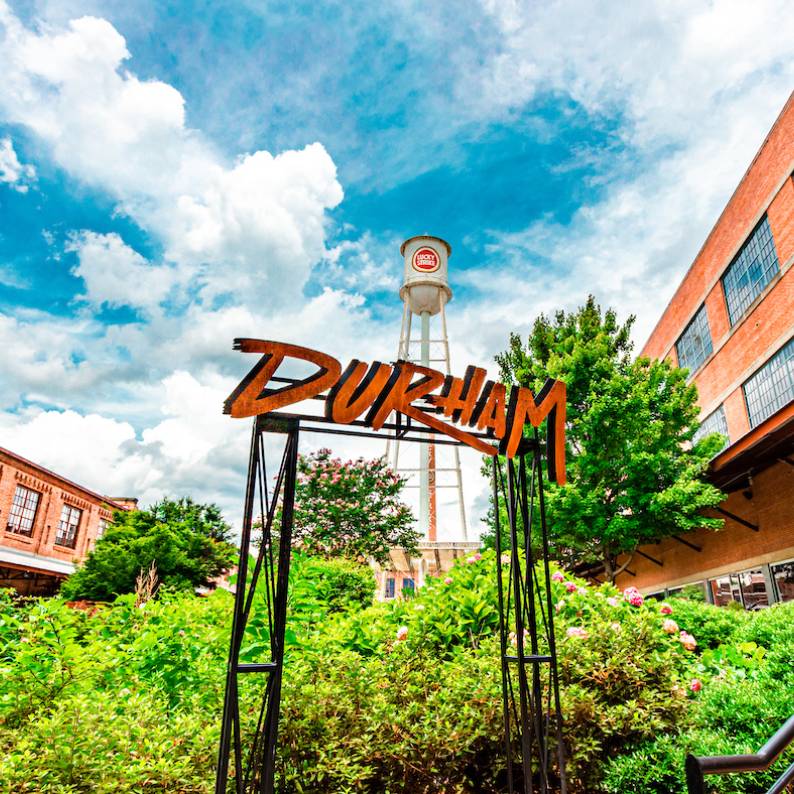
Film Locations - Historical Locations
- Site of the largest and one of the most significant surrenders of the Civil War
- 1700s Yeomen farm home and log kitchen, 35 acres of grounds, split rail fence along original roadway
- Historic encampments and re-enactments of negotiations between Generals Sherman and Johnson
- Visitor center with museum of Civil War memorabilia
- Restored 1920s Beaux Arts theater of ochre-colored brick
- 1,016-seat Fletcher Hall Auditorium with balcony includes buff-colored walls with turquoise and gold decorative finishes
- Cinema 1 (276 seats) and Cinema II (76 seats) are decorated with unique motif stencil designs
- Two elegant ballrooms and two large concessions lobbies decorated in teal, mahogany and gold
D.C. May Warehouse
215 Morris St
- 100,000-square-foot Romanesque Revival Style building features elaborate brickwork, dozens of segmental arched windows in narrow, recessed three-story bays
- Used as location for Bull Durham in 1987 (baseball offices and locker rooms)
Duke Chapel
Duke University, Chapel Dr.
- Built in 1930, one of the last great collegiate English Gothic projects with ribbed vaulted ceiling, buttresses and pointed arches
- Features a Flentrop 5,000-pipe organ, 210-foot tower housing a 50-bell clarion
- Intricate stained-glass windows and 291-foot aisle
- Seats 1,700
- Smaller memorial chapel (seats 50), includes a crypt with three marble tombs of the Duke University founders
- 77 stained glass windows, depicting some 800 figures
- Historic buildings on 45-acre site include tobacco curing barn, a tobacco packhouse, one of Washington Duke's tobacco log factories and the Duke Home
- Family home: a modest two-story, four-room, one-room-deep house built in 1852
- Interior of house sheathed in unpainted hand-dressed heart of pine boards
- Tobacco Museum chronicles tobacco and cigarette production and marketing
- Museum includes animated, computer-operated farmer character who talks about tobacco farming in this part of the state in the 1920s
- Living history demonstrations of life on a typical yeoman farm in the 1800s
Durham Armory
220 Foster St
- Yellow brick, constructed in 1937 with short crenelated towers at the corner and terra cotta tile roof
- Decorative brickwork at the cornices, narrow clerestory windows and tall arches line the first-floor elevations
Historic Durham High School
N Duke St
- 1923- Neoclassical Revival style design, features denticulated cornice, keystones above windows
- School campus includes auditorium, gymnasium and music wing and is now the Durham Magnet Center for performing arts
Durham Hosiery Mill #1
803 Angier Ave
- 1902 - marked by Romanesque Revival-style six-story tower, segmented and round arched windows and elaborately corbelled bands, arches and panels
Erwin Mill
2200 W Main St
- Built in 1893, this red brick cotton factory features decorative brick throughout
- Dropped-shoulder lintels with simulated dentilling at each segmental arched window
- Office building contains arched vents in each of the gables and a wraparound porch with turned posts, sawn spandrels and frieze of turned millwork
GTE Building
Roxboro Rd
- Four-story Neo-Georgian architecture
- 1.1 million handmade bricks laid in Flemish bond
- 80,000 square feet on 40-acre site with front balcony portico supported by four columns
Hill Building
(CCB Bank Building)
- 111 Corcoran St
- 17-story modernistic skyscraper built in 1935
- Architectural firm which designed the Empire State Building
- Art deco ornaments, interior fluted doors and exquisitely crafted letter box
- Historic St. Joseph's AME Church (1891) is a blend of Richardsonian-Romanesque and Gothic Revival
- Church features a hilltop view of Downtown and a grand steeple
- 23 stained glass windows
- Adjacent cultural center opened in 1991 with two art galleries, mirrored dance studio, classroom and community room
Historic Stagville
Old Oxford Hwy
- Late 18th and 19th-century plantation buildings occupy 71 acres of scenic, forested farm lands, formerly at the center of one of the largest plantation holdings in the South
- Horton Grove consists of four timber-frame houses built in 1851 as original slave quarters
- Pine planks on the floors are 20' wide and the wooden walls are filled with brick
- Great barn (135'x33') constructed in large sections called "bents"
- Great barn's massive timber frame was built in 1860 by highly skilled slave carpenters
NC School of Science and Mathematics
(Formerly Watts Hospital)
1219 Broad St
- 1904, fifteen-building complex built as a hospital and nursing school
- Modified Spanish Mission-style architecture
- Stuccoed exterior wall and red tile roofs
- Renaissance Revival-style entrance bays, arcaded loggia and wrought-iron balconies
- Lobby has marbled floors, wall dadoed in oak and two fireplaces
- Operating room designed with glass wall and ceiling to operate by sunlight
- First state-wide residential public high school
Old Durham County Courthouse
201 East Main St
- Renovated 1916 Neoclassical revival building of Indiana limestone
- Facade of fluted stone pilasters with Corinthian capitals, solid brass doors and stone balconies
- Interior includes brass for the balustrades of the white Vermont marble staircases
Patterson's Mill Country Store
5109 Farrington Rd
- 1870s reconstructed turn-of-the-century Country Store with doctor's office and pharmacy, with finest collections of mercantile Americana in the country
- Clapboard two-story structure with full front porch, period billboard and gas pump, vintage advertisements.
- Wraparound balcony overlooks interior filled with glass jars of penny candy and three 1890 brass cash registers.
Quail Roost Farms
123 Quail Roost Farm Rd
- 700-acre working horse farm built in the 1930s has become one of the nation's leading stable and dairy farms
- Perfect example of rural NC, with four horse barns and hay silos
- Country road runs through the property of rolling hills a with small pond, hardwoods and pines
- Several period farm estate homes
Spruce Pine Lodge
Off Bahama Rd
- 1940s vintage log building overlooking lake in forest setting
- 2500-square-feet of floor space
- Four separate rooms plus kitchen
- Log walls and massive stone fireplaces, located on large lawn and play field with picnic shelter overlooking Lake Michie
Stanford L. Warren Library
1201 Fayetteville St
- Symmetrical Colonial Revival-style brick building constructed in 1940
- Temple-style elevation at the entrance bay and a large Palladian window in each end elevation
- Interior has terra cotta rondel reliefs portraying classical figures
US Post Office
323 E. Chapel Hill St
- 1934 Neo-classical Revival style building, on the National Register nomination for the Downtown Durham Historic District as "conservative stylistically but designed with great attention to detail"
- Colonnade of eight monumental columns dominate the exterior, topped with green tile roof
- Interior handsome classical detailing in iron, brass, copper and marble decorate the lobby