Historic Places & Landmarks
Contains many instances of funereal art and the graves of many of Durham’s early African-American business and community leaders. Located next to White Rock Baptist Church.
[ more info ]
Brightleaf Square
These repurposed, 1904 Neo-Romanesque brick tobacco warehouses have been home to locally owned shops and acclaimed restaurants since their renovation in 1981. On the National Register of Historic Places, the buildings now anchor a Downtown dining, shopping, and entertainment district.
[ more info ]
Bullington Warehouse
Last of the brick tobacco warehouses to be built in Downtown Durham in 1927. On National Register of Historic Places.
[ more info ]
The Old City Stables, later the City Garage (late 1930s), have been transformed into City Place. Both the main building and the former Fire Drill Tower are listed on the National Register of Historic Places.
[ more info ]
Duke Memorial United Methodist Church
Built in 1907, the twin-towered, Gothic Revival-style church named for Washington Duke features 10-bell, manually-operated carillon (performances nightly) and Holtkamp organ.
[ more info ]
One of the nation’s top universities, founded as Trinity College and renamed in 1924 after James Buchanan Duke. Highlights include Duke Chapel, Sarah P. Duke Gardens, Cameron Indoor Stadium, Duke Forest, Duke Lemur Center and Nasher Museum of Art.
[ more info ]
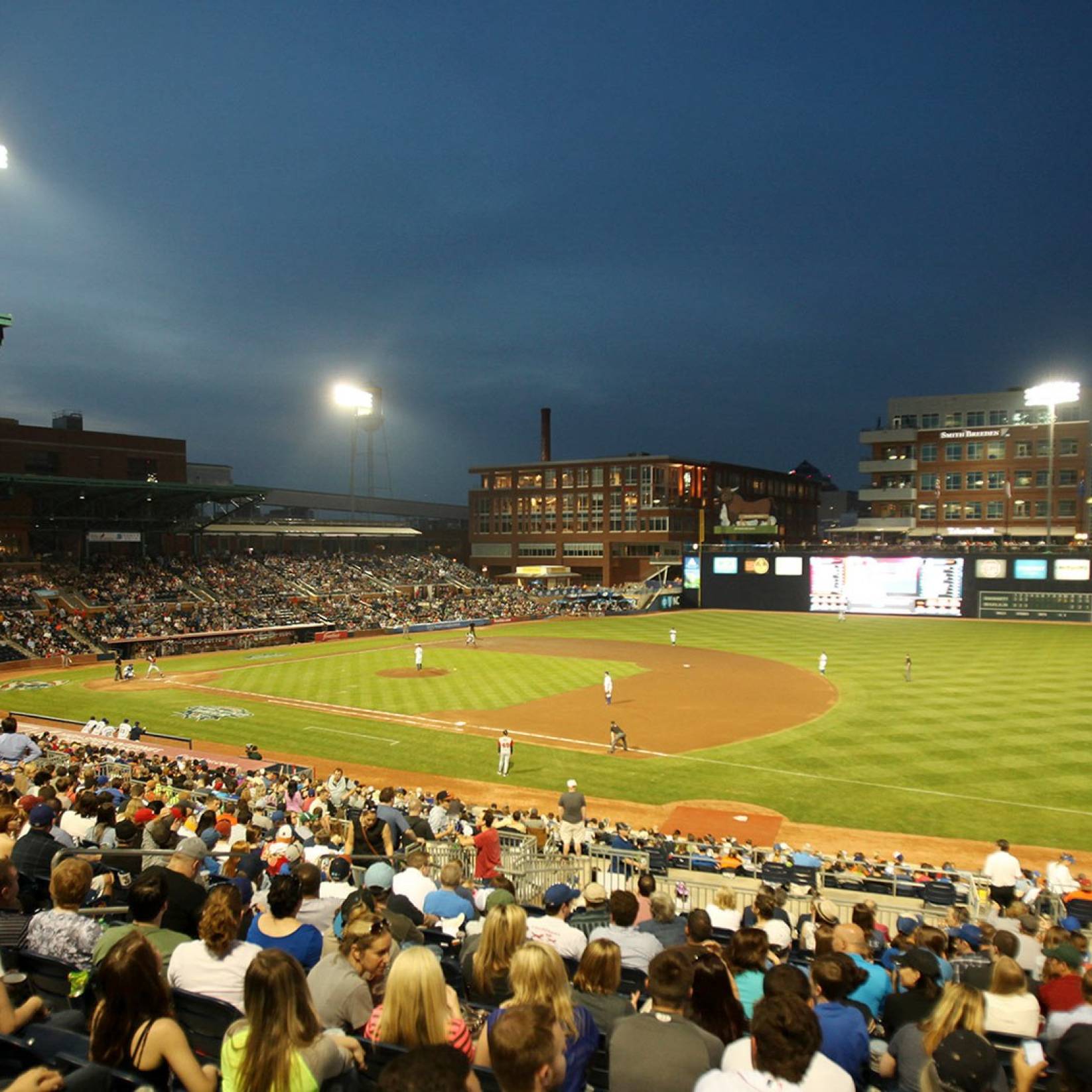
Nationally-acclaimed, 10,000-seat Downtown home of the Durham Bulls Triple-A baseball club, made famous by the movie "Bull Durham." Includes historic ambiance, skyboxes, and year-round Ball Park Corner with Bulls' memorabilia.
[ more info ]
Built c. 1902 as the nerve center of the world's largest hosiery mill complex. Today it provides housing for seniors. On National Register of Historic Places.
[ more info ]
Erwin Mills
Built in 1893, the mills originally produced tobacco bags and later became nation's largest producer of denim. Remaining buildings serve as office space and apartment homes.
[ more info ]
This 1916 building with German stained-glass windows stands on the site of two previous churches built by the congregation in 1875 and 1890. Currently led by Pastor Joseph S. Harvard.
[ more info ]
Former Wright's Automatic Machinery Co. Building
The factory dates from 1941 and is notable for its ties to Durham business titan Richard Harvey Wright and its own role as a supplier to the U.S. Navy during World War II and NASA up to the present day. Every spacecraft NASA has flown, including the Space Shuttle and the International Space Station, has carried parts made in the Durham factory, according to the city's landmark-designation report.
[ more info ]
Geer Cemetery
First cemetery for African-Americans in Durham, including the founders of White Rock Baptist Church and St. Joseph’s AME Church and organizer of the Hayti neighborhood. Includes some funereal art.
[ more info ]
Once a historic textile mill campus founded by Julian Carr; now a creative arts hub featuring unique dining and shopping, a live music venue, art galleries, green space, festival space, live/work lofts, creative office space, and 35 artist studios. On National Register of Historic Places.
[ more info ]
Runs through Durham along present-day Snow Hill, St. Mary's, and Mason Rds. Famous Piedmont fur and deerskin trading route through what is now Durham. After 1670, used by European explorers, hunters, and settlers. Passes Arrowhead Inn (circa 1774), Historic Stagville, and Hardscrabble Plantation, all dating to the late 1700s.
[ more info ]
Greystone Inn and Conference Center
Granite and brick mansion, built in 1911 for James Edward Stagg, a Durham banker, textile manufacturer, and railroad executive, is the last remaining Chateauesque-style dwelling in Durham and one of only a few in the state. Now a unique meeting venue and bed & breakfast inn with eight guest rooms.
[ more info ]
Historic Durham Athletic Park
Former home (1926-94) of the famous Durham Bulls and film location for the movie Bull Durham. Home to the NCCU Eagles; the Bulls play a mile south in Durham Bulls Athletic Park.
[ more info ]
In the early 1900s, African-American businesses prospered along what became known as "Black Wall Street." In the 1960s, Civil Rights pioneers staged sit-ins here and received a memorable visit from Dr. Martin Luther King, Jr. Features NC Highway Historical Marker and six bronze sculptures commemorating the history of the street, and is the location of the Historic Parrish Street Forum, a meeting space that will also serve as a history education resource.
[ more info ]
Over 100 acres of history dating to 1869. Civil War veterans and soldiers, tobacco magnates, and community leaders rest here, including the Duke and Carr families. Many gravesites marked with Victorian funereal art.
[ more info ]
Built around 1750 as a non-denominational meeting house. Transformed into a Methodist church in 1808.
[ more info ]
North Carolina Mutual National Historic Landmark / M&F Bank Building
The Parrish Street branch of M&F Bank, one of the oldest black-owned bank in the country. Originally built in 1921 for NC Mutual Life Insurance Co, the Neo-Classical Revival building serves as a symbol for Durham's "Black Wall Street."
[ more info ]
Old Bull Building
Built in 1874 at the height of popularity of the W.T. Blackwell and Company's world-renowned "Bull Durham" tobacco brand. Now a National Historic Landmark containing upscale residences.
[ more info ]
Renovated 1916 Neo-Classical-Revival building made of Indiana limestone. Facade of fluted stone pilasters with Corinthian capitals, solid bronze doors, and stone balconies.
[ more info ]
Orange Street Mall
Brick walkway named for a 19th-century tobacco brand “Orange of Durham.”
[ more info ]
Organized as a hunt club in 1875, it became one of the nation's leading stables and dairy farms. Riding lessons available.
[ more info ]
1909 Spanish Colonial-style building, built with leftover materials from the 1909 Watts Hospital. Recently renovated by the Center for Community Self-Help.
[ more info ]
The Oren Belvin House
[ more info ]
The Russell School
Built in the 1920s and named for local supporter Thomas Russell, this is one of two historic Rosenwald schools in Durham County. The Rosenwald Fund, started by Julius Rosenwald and Booker T. Washington, aimed to improve African-American education in the South by building schoolhouses.
[ more info ]
The Sessoms-Markham House
[ more info ]
1924 Gothic Revival church noted for woodcarvings. Famous members included Soong Chiao-chun, one of the leaders of China's 1911 Chinese Revolution, whose two daughters married Chiang Kai-shek and Dr. Sun Yat-sen.
[ more info ]
Once home to Durham's largest independent tobacco leaf broker, the Venable Center (c. 1905) has undergone an award-winning redevelopment into office, lab, and retail tenants. Listed on the National Register of Historic Places, the 90,000-sq.-ft. campus was also used as a film site for the 1996 thriller Kiss the Girls.
[ more info ]
Founded in 1866, this congregation was served for many years by Dr. Augustus Shepard, father of N.C. Central University founder Dr. James E. Shepard. Dr. Martin Luther King, Jr. addressed its congregation with a history-making civil rights speech following the 1960 Woolworth lunch counter sit-in in Durham.
[ more info ]
Sauda Zahra: "With these Hands: Quilting as a Spiritual Odyssey" Exhibit
Art quilts by Sauda Zahra, in the Ella Fountain Pratt Legacy Gallery. FREE admission.